RESEARCH TOOLKIT
  • Research Overview
    • What is Research?
    • The Research Process
    • Teacher Resources
  • Getting Started
    • Understanding the Assignment
    • Getting Organized
    • Finding Focus: Subject, Topic, Guiding Question
  • Gathering Info
    • Types of Information Resources >
      • GUHSD Online Databases
      • Browse Databases by Type
      • Searching Google Smartly
      • Using Wikipedia Wisely
      • GUHSD Library Catalog
    • Using Keywords for Searching
    • Taking Notes and Tracking Sources >
      • Note-Taking Strategies
  • Analyzing Info
    • Evaluating Information >
      • Avoiding Fake News
    • Developing a Thesis and Argument
    • Using Supporting Evidence
  • Presenting Findings
    • Paper/Essay >
      • MLA Format
    • Live Talk
    • Visual
    • Video/Audio
    • Website
    • GUHSD Virtual Makerspace
​After 6/5/25, this website is no longer being updated.

Avoiding Fake News


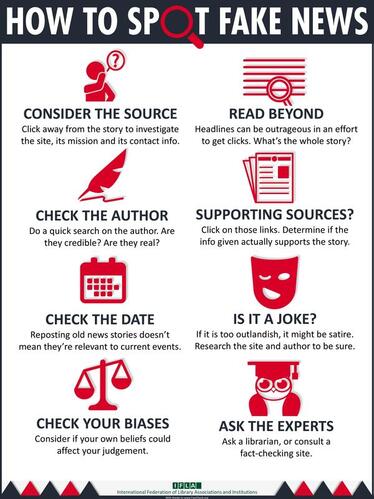
Hot to Spot Fake News infographic: Consider the Source, Check the Author, Check the Date, Check Your Biases, Read Beyond, Supporting Sources?, Is it a Joke?, Ask the Experts
Source: How To Spot Fake News, International Federation of Library Associations
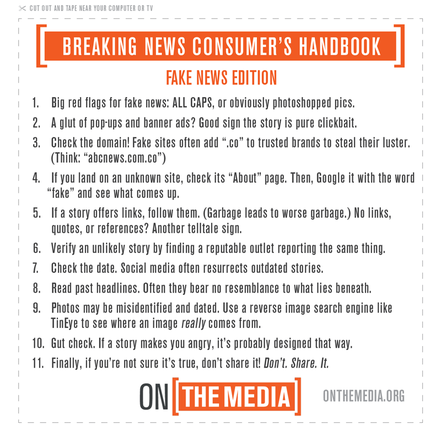
Breaking News Consumer's Handout: Fake News Edition Infographic
Click on image above to view larger
Source: Breaking News Consumer's Handbook: Fake News Edition, WNYC On The Media
Source: The News Literacy Project
Don't Get Fooled: 7 Simple Steps

​Fact-Checkers

What exactly are fact-checkers? Resources that help you check the accuracy of facts based on a Code of Principles. Click here to learn more about the main ones, which abide by the code and are linked below..
FactCheck.org
WaPo Fact Checker
PolitiFact
Snopes
To watch more videos, check out Edutopia's 5-Minute Film Festival: 9 Videos on News Literacy
Why News Literacy Matters

More News Evaluation Tools

  • The Language of News Literacy - Glossary of terms
  • Today's Front Pages - Compare news front pages
  • Who Owns What - See what media companies own
  • Whois Lookup - Look up who owns a web domain
  • ​Gizmodo Fake - Also, links to tools to detect hoaxes​

Learn more about fake news and how to avoid it

  • Free eBook​: Web Literacy for Student Fact-Checkers (Mike Caulfield)
  • Overview: Evaluating Resources: What is News? (Laura Preble, Monte Vista High School, GUHSD)
  • Overview: False, Misleading, Clickbait-y, and Satirical “News” Sources (Melissa Zimdars, Merrimack College)
  • ​Free eBook: Verification Handbook (Poynter Institute)

Popping Filter Bubbles

In addition to fact-checking, be aware of "filter bubbles" that may limit your understanding. Challenge yourself to learn about different perspectives!
  • ​AllSides.com - To compare coverage of news
  • NewsCompare - Compare snapshots of "homepage" coverage from across the political spectrum.
  • Blue Feed, Red Feed - Wall Street Journal tool comparing news from live Facebook feeds
  • Party Lines - Misleading talking points by both parties
  • ​How Facebook News Feed Works - See how it works
  • Apply Magic Sauce - How you are being categorized?

For Teachers [on red apple]
There are many more resources related to information and media literacy. Contact your school librarian to collaborate further.

Even more fake news resources for teachers

  • Brief Overview: The Honest Truth about Fake News...and How Not to Fall for It (with Lesson Plan) (Matthew Green, KQED)
  • Longer Overview with Links: Truth, Truthiness, Triangulation: A News Literacy Toolkit for a “Post-Truth” World (Joyce Valenza, School Library Journal)
  • Article: Most Students Don’t Know When News Is Fake, Stanford Study Finds (Sue Shellenbarger, Wall Street Journal) and Full Executive Summary 
  • Curriculum Resource (free registration): NewseumED
  • In-Depth Curriculum Resource: Digital Resource Center: Center for News Literacy (Stony Brook University)
  • Discussion Board: Level Up Information Literacy (Closed Facebook group you are welcome to join for continued discussion)


MORE ON EVALUATING INFORMATION
Powered by Create your own unique website with customizable templates.
  • Research Overview
    • What is Research?
    • The Research Process
    • Teacher Resources
  • Getting Started
    • Understanding the Assignment
    • Getting Organized
    • Finding Focus: Subject, Topic, Guiding Question
  • Gathering Info
    • Types of Information Resources >
      • GUHSD Online Databases
      • Browse Databases by Type
      • Searching Google Smartly
      • Using Wikipedia Wisely
      • GUHSD Library Catalog
    • Using Keywords for Searching
    • Taking Notes and Tracking Sources >
      • Note-Taking Strategies
  • Analyzing Info
    • Evaluating Information >
      • Avoiding Fake News
    • Developing a Thesis and Argument
    • Using Supporting Evidence
  • Presenting Findings
    • Paper/Essay >
      • MLA Format
    • Live Talk
    • Visual
    • Video/Audio
    • Website
    • GUHSD Virtual Makerspace
